Friday, August 12, 2011

Bacon-Wrapped Chicken with Sage Leaves


These are fun to eat with your fingers. Cut in half, they'd make great hors d'oeuvres.

Here's a nifty and simple recipe that I'll be making again. I grow "purple sage" which is what I used. This is the kind of recipe that is more a "procedure" than ingredients exactly measured out.


  • Fresh sage leaves
  • Chicken tenders
  • Seasoning (I used garlic powder, Lawrey's,  Bell's Seasoning*, and freshly cracked pepper)
  • Bacon, one slice per chicken tender
  • Olive oil


Wash and pat dry the chicken tenders. If large, snip out the white tendon. Lightly season with seasoning of your choice. Place sage leaves the length of the tenderloin.


Wrap each with bacon. If your bacon has "fatty ends," trim. Wrapping can be a bit tricky. I found it easier to lay the tenderloin on top of the bacon, about an inch or two below the top end. Fold that end down on the chicken and then begin wrapping the the long end around it, raising the chicken up from the board as you go and stretching it a bit as you wrap it.


Grind fresh pepper over the wrapped chicken. Heat a pan over medium-low heat and drizzle just a bit of olive oil in the pan. Place bacon-wrapped chicken, sage side down. Fry until brown, about 6 minutes or so. Flip and crisp the other side. Remove to paper towel to blot and serve warm. 

Notes: This is adapted from "Everyday Food." They used one large sage leaf per tenderloin and really didn't season the chicken. It's up to you. As an experiment, I did use pancetta with one which made wrapping easier, but I preferred those made with the bacon. I wouldn't grill these. Why? You want the sage leaves to 'crisp' as they fry. Grilling would just burn them.

*I love Bell's Seasoning. It is heavy on the rosemary and perfect for any poultry. And the little box is just beautiful packaging.




Wednesday, August 3, 2011

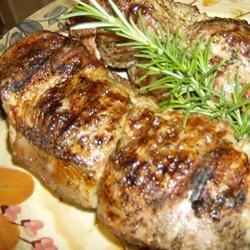
Grilled Pork Tenderloin with Rosemary and Garlic


You really need a grill for this recipe, either gas or charcoal. I've made it in the oven, but it's not half as good. I've also seared it in a cast-iron skillet and then finished it off in the oven. Better, but not the same as seared over an open flame. Fire does magic to rosemary and garlic and adds needed smokiness to the pork itself so all the ingredients roast into one great recipe. Sometimes I put a branch of rosemary on top of the pork as it roasts so the heat releases the oils.

This simple marinade isn't overpowering and complements the delicate pork taste. Look for tenderloins on sale. Usually, there are two per pack. And don't confuse pork tenderloin with pork loin--they are two different cuts of meat, the tenderloin living up to its name--more tender and very lean, but usually quite moist. If you are having guests, this is a great recipe. You can marinate the meat the day before and grilling is a snap. Several tenderloins will feed quite a few people.

I like my pork grilled until there's just a hint of a pink blush in the center--around 145 F. (It will continue to cook when resting. When done,  remove from grill and place on plate. Tent with foil and allow to rest about ten minutes. Save collected juices and add just a tad of water and a teaspoon of butter. Microwave just until bubbly. Cut the meat into thin slices and drizzle gravy over the top.
  • 2, 3/4 lb. pork tenderloins
For each tenderloin:
  • 1 large garlic clove
  • 1 teaspoon Kosher salt, divided
  • 1/4 teaspoon ground pepper
  • 2 teaspoons fresh rosemary, finely minced
  • 1/2-1 teaspoon minced thyme leaves (optional)
  • 1-2 tablespoons olive oil
Finely chop the garlic. Leaving it on the cutting board, add 1/2 teaspoon salt. Using the flat end of your knife and, working it back and forth, work the salt into the garlic forming a kind of paste. Or just use a mortar and pestle.

Remove to a small bowl. Add rest of ingredients and mix. Coat the entire tenderloin with the mixture. Sprinkle the top with about 1/2 teaspoon of Kosher salt. Wrap in plastic wrap. Refrigerate for at least several hours (I've gone as long as two days.)


About 30 minutes before grilling, remove from refrigerator and unwrap. Keep the marinade mixture on the meat.

It there's a thin "tail" on the tenderloin, fold it under and secure with a toothpick or tie it in place to create a uniform, round tenderloin.

Pre-heat grill and cook on moderate, about 350 if using a gas grill, turning every once-in-a-while until done. I like 145 F, for safety, they say about 160 F degrees, anywhere from 20-30 minutes depending on thickness of meat.

Makes great, cold sandwiches if there's any leftover.

Notes: If at all possible, use "home-grown" rosemary. The flavor is more pronounced and sharper than store-bought. The older the rosemary bush, the better the taste.

Monday, August 1, 2011

Individual Peach-and-Ginger Upside-Down Cakes

Simple as sin to make . . . and, oh, so heavenly to eat!

This is an Alton Brown recipe. And it's truly a winner! I followed it to the letter but added a few sprinkles of cinnamon to the buttermilk batter. The key here is to have firm, ripe peaches. The combination of peach, ginger and brown sugar is classic. Vanilla ice cream or whipped cream, in my opinion, simply detracts from this gorgeous little dessert. 


Ripe peaches and ginger are a classic duo.


  • 2 firm ripened peaches
  • 3 tablespoons minced candied ginger (1 ounce)
  • 1/4 cup light-light brown sugar, divided
  • 2 tablespoons cold butter
  • 1/2 cup all-purpose flour (2.5 ounces)
  • 1 teaspoon baking powder
  • 1/8 teaspoon baking soda
  • 1/8 teaspoon Kosher salt
  • Cinnamon (optional) a few shakes
  • 1/2 cup buttermilk (shake before using)
  • 1 tablespoon melted butter
  • 1/2 teaspoon vanilla
  • 1/3 cup sugar
  • 4, 6-ounce ovenproof ramekins

Preheat the oven to 350 F degrees. Spritz the ramekins with a bit of cooking spray. Place on a baking sheet.

Divide the 2 tablespoons butter evenly among the ramekins. (Simply cut the two tablespoons of cold butter in half, then cut each half in half and then half again). Now evenly distribute the brown sugar over the bottom of each ramekin one tablespoon at a time (four tablespoons = 1/4 cup).

Each ramekin will get 1/2 of a peach. Cut the peach in half and pull apart. Remove the pit.  Now cut the 1/2 piece in half again and then peel it with a sharp knife. Cut each quarter into 4-6 slices for a total of 8-12 slices and place on top of the brown sugar and butter.

Evenly distribute the minced, candied sugar over the surface of the peaches in each ramekin.


Measure the flour, baking powder, soda, salt and cinnamon (if using) in a small bowl. Mix to incorporate.

In a medium bowl, mix and dissolve the sugar in the buttermilk, melted butter and vanilla.

Add the dry ingredients to the wet by hand with a spoon or whisk just until mixed through. Don't dawdle when doing this. The reaction of the buttermilk and baking powder begins immediately.

Divide batter evenly over the peaches.

Place filled ramekins on the baking sheet and bake 20-25 minutes until an internal temperature of 190 F degrees is reached. Mine took the full 25 minutes. 

Remove from oven and allow to cool a good 5-10 minutes. Don't be alarmed if they "fall" a bit. Run a sharp knife around the edge. Place a plate on top and carefully flip upside down to loosen the cake. 


Honestly, you really need to make this recipe!


These are great warm (not hot) and at room temperature.

Notes: Avoid buying small, name-brand jars of candied ginger that are overly priced. Instead, look for it in the dried fruit and nuts sections of the grocery store or at health-food stores where it less expensive.


Saturday, July 30, 2011

Potato Salad with Basil, Dill, and Lemon


P.S. Don't forget the PS!
This isn't your grandmother's potato salad. But next to hers, I love this one. It's simple and  "clean." Whenever I make it, usually in the summer months, I always question myself, "Why don't you make this more often?"

A cold potato salad is perfect fare for the hot summer months. And it goes with just about anything from hamburgers to steaks to salmon. It's a meal in and of itself with a fresh, from-the-garden tomato dressed with olive oil and aged Balsamic vinegar and a slice or two of sweet melon for dessert. It's not necessary to use fresh dill for this, but it is imperative to use fresh basil--and don't skip the lemon.

Use small red potatoes since they are waxier than Idaho potatoes. Scrub, but don't peel. After they are cooked, the peels will begin to slip off as you cut them. I like a bit of the peel to show in the PS. This recipe is easily cut in half. 

https://blogger.googleusercontent.com/img/b/R29vZ2xl/AVvXsEi8v7JiK2DiQr4kjugsks8-gIsfpRajTeBuZrnbYul3B0QNw4vYHCB31plnXvFiDwdITf4ajl8ir8mG7oUD9j3Ghyphenhyphen7oJVqJ_MC6t92Ty-2cfPGfKwbTdX2OnyJemzYGBX-YtRTthlfg2oTx/s400/Oven-roasted+red+potatoes2.JPG

  • 3 pounds red potatoes
  • 3 tablespoons rice vinegar (seasoned or unseasoned)
  • 3/4 cup real mayonnaise
  • 1/2 cup thinly-sliced green onions, white and green parts
  • 1/2 cup celery, diced (split large stalks into fourths lengthwise then dice)
  • 1/4 cup finely-chopped fresh parsley
  • 1/4 cup chopped fresh basil
  • 2 tablespoons chopped fresh dill or 1 tablespoon dry
  • 1 1/2 teaspoons finely grated lemon peel
  • Salt
  • Pepper
(Serves 6-8)

Lightly scrub potatoes and leave on the skin. If potatoes are large, cut in half. Place in a large pot of salted water and bring to a boil. Reduce heat to medium and boil just until tender, about 10-15 minutes or so until the tip of a sharp knife easily pierces the flesh. Drain. Rinse with cold water and drain. Allow to sit until cool enough to handle.

Cut potatoes into 3/4-inch pieces removing some of the peel as you go. Place one layer in a large bowl and sprinkle with a bit of the vinegar and salt and pepper. Repeat layers with vinegar, salt and pepper. Taste. Add more salt and pepper if necessary.

Sprinkle grated lemon peel over potatoes. Mix. Now add the rest of the ingredients. Mix thoroughly. Chill and enjoy (but I think it's wonderful still warm).


Notes: Potatoes take a lot of salt, so be sure to taste, taste, taste. When people complain that a potato salad is "bland," it's usually because it doesn't have enough salt. I've made this without the parsley and it's just fine. A garnish of radishes cut razor-thin makes a lovely presentation.