Friday, September 30, 2011

Scalloped Potatoes with Three Cheeses

Tender, soft pillows of potato and onion quilted with cheese and cream. What is not to like?

Use fresh cheeses for a great scalloped potato dish.

The first time I made this was for a family Christmas served alongside a beef tenderloin. Relatives still talk about it. What's not to like? Creamy potatoes baked with cheddar, Parmesan and blue cheese. Use quality cheeses that you grate yourself. If I use blue cheese, I generally use Maytag Blue. For the recipe below, I used Gorgonzola. Instead of using all milk, I use about 2/3 whole milk and 1/3 half-and-half. Either way, don't use reduced-fat milk. It's not unusual for the potatoes to look "curdled" during baking. That's okay. It generally works into a creamy sauce with the cheese. I generally use a mixture of shallots and yellow onions. 

A mandoline makes easy work of grating the potatoes. Do not use boiling or waxy potatoes. You want starchy Idaho spuds. 


(Adapted from Bon Appetit)
  • 3/4 cup grated (packed) extra-sharp Cheddar cheese (about 4 ounces) I prefer white, not yellow
  • 3/4 cup crumbled blue cheese or Gorgonzola (about 4 ounces)
  • 1/3 cup grated (packed) fresh-grated Parmesan (about 1 1/4 ounces) do NOT use the canned stuff
  • [I probably use a bit more of all the cheeses]
  • 4 pounds Russet potatoes, scrubbed, peeled, cut into 1/4-inch rounds (I think 1/8 is better)
  • 1 1/2 teaspoons salt, divided (I prefer Kosher)
  • 1/2 teaspoon black pepper, divided
  • 1/4 cup finely chopped yellow onion (I use a combo of onions and shallots)
  • 3 tablespoons all-purpose flour
  • 4 tablespoons butter
  • 3 cups whole milk (I've never used just milk. I use a combination of whole milk and half-and-half or all half-and-half)


Pre-heat oven to 400 F. Butter or spray a 13 x 9 x 2 glass baking dish (I recommend spraying with Pam).

In a medium bowl, mix together all the cheeses. Set aside.


Grate potatoes. Set aside. Either grate or finely chop the onion/shallot. Set aside.


Measure milk/cream mixture in a glass measuring cup. Microwave until warm. Set aside.

Using half of the potatoes carefully arrange them in rows in the baking dish, overlapping slightly. I go one row down the length, and then the second row across the width. Sprinkle with 3/4 teaspoon of the salt and 1/4 teaspoon pepper. Evenly sprinkle the onion mixture over it then the flour. Dot with 2 tablespoons butter. Sprinkle half of the cheese mixture over this and reserve the rest of the cheese. 


Now top with the rest of the potatoes, 1/2 teaspoon salt, 1/4 teaspoon black pepper and dot with remaining two tablespoons butter.

Pour warmed milk over the potatoes (it will not cover them completely). Tightly cover the dish with foil. Bake for 45 minutes. Remove foil (liquid may look curdled, that's okay, especially if using all whole milk). Evenly scatter the rest of the cheese over casserole. Bake an additional 45 minutes, uncovered until cheese is a deep golden brown and potatoes are tender and creamy.

Oh, my!

Remove from oven. Let sit a good 20-30 minutes before serving.

This recipe is easily halved. Bake in an 8 x 8 dish and adjust cooking time accordingly. I bake it covered for about 35 minutes and then uncovered for about another 40 minutes or so.

(This may be prepared two hours ahead. Let stand at room temperature. Cover and re-warm in 375 F. oven for about 20 minutes)

NOTES: People always love to add more cheese. Be careful. More cheese may add more oil and grease, not necessarily taste. A little cheese with potatoes goes a long way.

Cover with milk just until the top is barely covered or it will boil over. The trickiest part of scalloped potatoes is bake time. It's easy to underbake them. 

How much milk you use depends on the thickness of your potatoes. 



Tuesday, September 27, 2011

Scalloped Potatoes with Garlic and Goat Cheese

Spudlucioius!
I just kind of assume it's the French who had the culinary genius to bake ultra-thin layers of potato in cream. I mean, just look at that photo. Magnifique, n'est pas? It's a work of art!

Three kitchen utensils make this recipe a breeze to prepare: first and foremost is a mandolin. No kitchen should be without one. Next is a scale. How many times have you told yourself you were going to get one? You need two pounds of spuds. And last, but not least, a garlic press. Or a micro-plane. Okay, that's four.

A mandolin makes easy work of slicing potatoes. Always guard your fingers
and never look up while slicing. Keep your eyes on the task at hand.


Use large starchy Idaho potatoes, not red or yellow waxy ones. Use a good goat cheese. People who don't like goat cheese will love these potatoes. Trust me. This is Bon Appetit recipe. I used a flavored goat cheese instead of plain it called for and changed the process of preparing a bit.


  • 1 cup whole milk
  • 1 cup whipping cream
  • 1 5-oz. log garlic and herbs goat cheese, softened
  • 1 large garlic clove, pressed or finely minced
  • 1 1/2 teaspoons regular table salt
  • 3/4 teaspoon regular black pepper
  • 1/8 teaspoon freshly grated nutmeg (do not omit)
  • 2 pounds starchy potatoes, such as Idaho or Yukon Gold


Preheat oven to 400 F. Butter or spray a glass baking dish 11 x 7 x 2, which I prefer. But mine was out of commission at the time so I used an 8 x 8 which also worked.


Measure your milk and cream into a glass measuring cup and microwave until warm (not hot). Add your softened goat cheese and with the tines of a fork begin working it into the cream mixture so it dissolves. Add the garlic, salt, pepper and nutmeg. Taste and re-adjust seasonings, if necessary. Set aside.


Scrub and peel your potatoes. I don't peel, I just use a metal scrubbie to wash them well which removes some of the skin. Slice 1/8-inch thin. Save the largest slices to place on top of dish.


Place 1/3 of the potatoes on bottom of dish, overlapping slightly but neatly in rows. Whisk cream mixture and pour 1/3 on top. Continue layering and adding cream mixture 2 more times. I use the smaller pieces to place around the perimeter of the dish.


Bake uncovered for 1 hour and 10-15 minutes. Allow to rest a bit before serving.


Thursday, September 22, 2011

Turkey Soup with Dumplings and Meatballs

Savory-spiced ground chicken (or turkey) meatballs add depth to this rich soup.
Celery leaves make a great garnish for just about anything
and are usually on hand more so than fresh parsley.


This recipe has a few "twists." First, I no longer use "diced chicken or turkey" when I make turkey or chicken soup. I use ground chicken that I make into tiny meatballs, even for turkey soup. They add a ton more flavor and it's easy to incorporate spices into the mixture.

Where I live in the South, it's difficult to find good noodles. I have no idea why. And it's almost impossible to find broad flat noodles--they're twisted which I find, well, twisted. What's up with that? I bought some frozen "dumplings" that were already rolled out, but they were tasteless and I ended up tossing the box into the garbage.

In the Midwest I had access to Amish noodles or frozen Kluski noodles, all made with egg yolks and wonderfully fluffly. If you have access to them, by all means use them. But now, I just make my own. It's actually simple, especially if you have a mini-food processor. If you don't want noodles at all, sub in some rice. I whole-heartedly recommend Ream's Frozen Egg Noodles. Most grocery stores now carry them. 

Noodle. Dumpling. What's the difference? To me, these are "flat dumplings." They are made with egg, rolled out, and tend to puff up just a bit, unlike a noodle, as they absorb the stock. 

Speaking of stock--

For this recipe, it's important to use homemade. Either turkey or chicken will work. Canned does not cut it. 

When I first made this soup and gave it to friends, they all said they "wanted more." Trust me, it's those little meatballs and the homemade stock. Enjoy.

  • SOUP/BROTH:
  • 6-8 cups homemade turkey stock: Kitchen Bounty: Turkey Broth
  • 1/2 cup sliced carrots
  • 1/2 cup diced celery (less rather than more)
  • 2-3 tablespoons unsalted butter
  • Dumplings/Noodles the amount according to your preference

  • MEATBALLS:
  • 1 cup ground chicken (or turkey)
  • 1/2 teaspoon dried savory
  • 1/2 teaspoon onion powder
  • 1/4 teaspoon garlic powder
  • 1/2 teaspoon table salt and pepper to taste
  • 2-3 teaspoons dried parsley flakes

  • DUMPLINGS:
  • 1 cup all purpose flour
  • 4-6 tablespoons tepid water
  • 1/2 teaspoon olive oil
  • 1/2 teaspoon salt
  • 1/4 teaspoon baking powder
  • 2 egg yolks

Bring your turkey stock to a simmer and add carrots and celery. Taste for salt.

In a small bowl, mix together the ground chicken, savory, onion and garlic powder, parsley, salt and pepper. Be sure to mix really well. Set aside.


It's important to mix the spices well.


Place the flour, salt, and baking powder in a mini food processor. Pulse. Add egg yolks and olive oil. Pulse. With top on and motor running, begin dribbling in the water, pulsing backwards if necessary. When dough comes together as a mass and leaves the sides of machine, it's done. Remove from processor and knead one or two times. Cover with cloth and allow to rest 30 minutes.

Using the small end of a melon baller, scoop chicken mixture and add to turkey stock. It's not necessary to make them into a perfect "ball" shape. They will float to the top as you add them. As they cook, they will yield their flavor to the stock.I a

Ground chicken gives a lot more flavor to your soup that diced
chicken or turkey.


After 30 minutes of resting, cut the dough ball in half and roll on a floured surface. Roll to about the thickness of poster board or thin cardboard.


You may cut the dough any way you like. Sometimes I cut it into small squares. Sometimes I use a cake-decorator tip and cut out circles. I like small "dumplings" or noodles that fit on a spoon.


If making circles or other shapes, re-roll scraps of dough and then proceed with other half. Place dumplings into simmering soup. 

Bring to a nice simmer, not a boil. I tend to avoid "boiling" soups. Cover. Simmer for ten minutes. Lower to a slow simmer and taste for salt and pepper. Add butter. Cover and leave on low for 30 minutes or more. The dumplings will have "plumped" up a bit. The longer they sit in the soup, the better they will taste. 

Ladle into bowls. Garnish with celery leaves and, if desired, sprinkle with dill. I love it with dill.

Tuesday, September 20, 2011

My Favorite Baked Chicken Leg Quarters


Note how the meat of the lower leg has pulled away from the bone.
That means it's done. It's important to baste the last 25 minutes
to achieve this golden, brown skin. And you want just a bit
of that blackened spiced mixture.


(Update, June 13, 2012: Wow, I'm glad to see this as one of my top recipes! I make it all the time and hope you enjoy them as much as I do!)


I snagged a five-pound bag of chicken leg quarters at my grocery store on sale for only 2.99! That's a whole lot of eating for little money. And it's a brand I like. The quarters are both meaty and juicy.

You'll need a garlic press for this recipe. You want your garlic to be a "paste." Why? Well, when garlic is a paste, it's not apt to burn the way minced garlic will. If you don't have a press, simply mince your garlic fine and then put the salt on it and, using the broad side of a knife knead it back and forth, working the salt into the garlic until a paste is formed. Or just use a mortar and pestle.

I gnaw these babies to the bone and lick my lips!

  • 2 leg quarters
  • 2 large cloves garlic, pressed
  • 3/4 teaspoon dried thyme
  • 3/4 teaspoon Old Bay's Seasoning
  • 1/2 teaspoon Kosher salt
  • Pepper, freshly ground
  • 1/4 heaping teaspoon ground cumin
  • 2-3 teaspoons olive oil
  • 1/4 teaspoon Tabasco Sauce
  • 1 tablespoon butter 
  • 1-2 tablespoons (about) dry white wine


Pre-heat oven to 375 F. degrees

Remove any excess fat from leg quarters and rinse well under cool water. Pat dry with paper towels. Place in a shallow baking dish. I prefer metal.

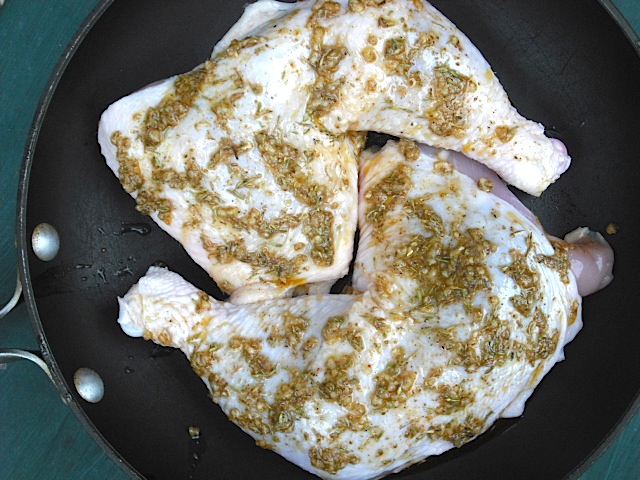
In a small bowl mix the garlic, thyme, Old Bay's, salt, cumin, Tabasco, and several good grinds of fresh pepper. Add olive oil a teaspoon at a time. Using the back of a spoon, mash all the ingredients together to kind of form a paste. Taste. The garlic flavor should be in the forefront along with some heat.

Coat the chicken evenly with the spice mixture.


Place pan in oven and bake at 375 for 20 minutes. After 20 minutes, remove the pan from the oven. Raise the temperature to about 425. Splash in two tablespoons dry, white wine into pan and one tablespoon butter. Swirl it around a bit to mix with the juices. When butter is melted, baste the leg quarters with the "sauce." Return to oven and continue to bake for an additional 25 minutes, basting several times. Basting is important to get that golden-crisp skin. I leave in oven for ten minutes then baste. After that, I baste two more times every five minutes.

Remove from oven and allow to rest 20 minutes before serving. I find I enjoy these much more after sitting for 20 minutes or so. Just out of the oven, they're too hot to handle. I like to be able to pick one up and bite into it to get a  mouthful of crispy skin and juicy meat.

Chicken quarters should be cooked to an internal temperature of 165-170 F degrees. Because they contain much cartilage and fat, they are forgiving if you cook them longer. 

Notes: If your legs quarters are on the small side, reduce cooking time by several minutes. Try to cook leg quarters that are about all the same size. I've also done this with just thighs.