Saturday, March 9, 2013

Traditional Irish Soda Bread ....


March is that time of year when all things turn Irish. Even Easter, if it arrives early!

Food, such as this, once had a purpose. A real purpose. It was meant for sopping into hearty stews to mop up rich gravy; dipping into bacon grease after frying eggs and bacon; soaking into soups. The dense, interior texture with the crisp, chewy, outer crust, deliciously withstood such gastronomical rigors and acrobatics. Try doing any of the above with a simple piece of white bread...and it just falls apart.

Since Irish soda bread only uses four ingredients, it was simple to quickly assemble and to  have ready for supper.

Refined, soft, white flour was not a staple of Irish homesteads 150 years ago. Their flour was coarsely ground with flecks of bran. Even back then, "the white stuff" was reserved for the wealthy.

The following recipe uses bread flour with a higher concentration of glutens and less "silkiness" of white flour which will make your bread crumble as you cut it. To achieve the "coarseness," I added one cup of rye flour.


It's important not to overwork your dough. Don't worry if some of the flour remains in the bowl. Do not add any sweetener, such as brown sugar, white sugar, honey. You want the earthy grain tones in the forefront.

Some recipes call for flouring a non-greased pan before baking. Don't. There's nothing worse than the flavor of burnt flour. Use a sheet of parchment paper.

This loaf will produce a tender-chewy outer crust and hearty interior. DO NOT, under any circumstances, attempt to cut this or any loaf of bread while it is hot from the oven. Once removed from the oven, it's important for the bread to "steam." Cutting it, releases that steam which results in a dry loaf.

Even one-day old and wrapped in cling-wrap, the bread will retain a toned-down crispy crust. It makes for wonderful sandwiches.


  • 2 1/2 cups bread flour mixed with 1 cup rye flour for a total of 16 ounces*
  • 3/4 teaspoon baking soda
  • scant 1/4 teaspoon baking powder
  • 1 teaspoon all-purpose salt
  • 1 3/4 cup buttermilk (be sure to shake it before using) plus 1-2 tablespoons set aside


You will need a LARGE bowl for the mixing.

Place dry ingredients in a bowl. Using your hand, whisk your fingers through the flour to incorporate salt and soda.

Make a well in the center and pour in the buttermilk.

Make your hand into a "claw" with outstretched fingers and begin mixing in a circular motion from the center to the outside of the bowl. Yes, it's messy. This should take no more than 15 seconds or so. If necessary add another tablespoon or two of buttermilk.

Tip the dough onto a flour-covered board. Begin shaping by cupping the mound of dough between your palms as you turn turn turn on the board to form a soft ball. Tuck under any loose ends.

Gently pat the ball to form into a seven-inch circle. You want a disk about 1 1/2 - 2 inches thick. Place disk on a parchment-paper baking sheet. Brush with additional buttermilk.

It is traditional to "bless" the bread by cutting a cross into it about 1/2 inch deep. Make a slash in each quadrant to allow "the evil fairies to escape" so the bread has a nice rise as it bakes.


Place in center of a 450 F degree oven and bake for 15 minutes. Lower heat to 400 and continue to bake another 15-20 minutes.

Turn over bread and continue to bake another 5-10 minutes or until it sounds hollow when tapped.

The underside.

Remove from oven and place on a wire rack to cool. When cool enough to handle, cut the loaf in half and then begin slicing from the heel.


*Or 2 1/2 cups all-purpose flour and 1 cup whole-wheat flour or rye flour for a total of 16 ounces.


"Americanized" Irish soda breads are sweet with the addition of sugar, eggs and dried fruit. That recipe can be found here: Kitchen Bounty: Irish Soda Bread.



Monday, February 25, 2013

Making Bread Using a POOLISH


 My white bread loaf using a poolish. The rise was incredible! The taste even better!


I probably make a loaf of bread at least every other week (my recipe is here: Kitchen Bounty: Daily Bread use as a guide for how to shape bread before baking). Quick-rising yeast makes it quite easy. If I start in the a.m., it's done by noon. But one thing I don't like about quick-rise yeast is its insipid or "un-yeasty" taste. I want more. To make it stronger and more pronounced, I allow an extra rise of the dough before shaping it into a loaf.  This allows time for the yeast to do its thing.

I've considered sourdough recipes, but I really don't want to mess with starters--all that feeding, etc. I'm a procrastinator by nature. That's when I began to read about making a poolish (poo-leesh). It easily solved the taste problem I desired.

Simply put, a poolish is a combination of bread flour, water and yeast. It's mixed the night before and covered. In the morning, it's all bubbly and elastic.


From that, you form your bread dough. It has a great aroma with just a hint of sourness that is not overbearing.

Because I use my bread primarily for morning toast and sandwiches, I do not free-form my dough. I put it in a loaf pan. I have beautiful black metal pans just for bread, but I find myself using my glass Pyrex loaf pan more and more (try finding an older one, they are expensive!). It allows the sides to bake into a light golden color without being overly crisp. For the loaf pictured, I placed a pan of hot water in the bottom of the oven, but it made the top too crisp for me.

Poolish
Prepare the night before: 
  • 10 oz. water (about 1 cup, + 3 tablespoons)
  • 10 oz. bread flour (2 cups)
  • 1-2 tablespoons liquid fat (melted butter, shortening, lard; I used olive oil)
  • 1-2 tablespoons sugar (I always use honey but you can use white or brown sugar)
  • 1/4 teaspoon quick rise yeast from packet. Save the rest of the packet. 
Using a whisk, blend all ingredients in a heavy bowl until smooth. Cover firmly with cling film. Poke a hole in the center using your finger (so the yeast can breathe) and place in a warm area. I place on the top of my refrigerator. Notice that no salt is added. Salt and yeast do not get along at first. They need to be introduced gradually ... 

In the morning, you should have a wonderful bubbling mass. If you lower your ear to it, you will actually hear the fermentation. (If you have children about, ask them to listen. It's akin to listening to conch shells for the echo of the ocean.)

At this stage, some recipes call for adding more water, but that only gives you more "holes" in your bread. I'm not interested in bread that won't hold butter and jam, so I skip it.
  • To the poolish, add one room-temperature, beaten egg yolk. This is entirely optional, but I have learned the yolk will give a more tender crumb. Do NOT add the entire egg since the white has an adverse effect on both the rise and texture of the bread! Sprinkle the rest of the packaged quick-rise yeast over it and gently stir.
  • Remove the mass to a floured surface and begin kneading in 2 more cups of bread flour. Now that the yeast has been allowed to do its thing, introduce 1-2 teaspoons of salt until an elastic bread ball forms and no longer sticks to the surface. You have to decide on what kind of salt determined by the size of the  crystals. Ordinary table salt has smaller crystals, so use the lesser amount. Use that as your guide.
Place in a greased bowl (I use olive oil) and allow to double. It won't take long ... check after 30 minutes.

Gently deflate (some recipes call for "punching." Never "punch" anything!) and give a second rise which usually takes less time than the first ... so keep your eye on it.

Grease your bread pan. I prefer lard or tallow, even Crisco. Form into a loaf (see above for Daily Bread instructions).

Place into greased pan and allow to rise to the top. Slash down the center for a classic look with a razor blade or very sharp knife and bake in a 350 F oven for 30-40 minutes or until it registers 200F on a quick-read thermometer. 

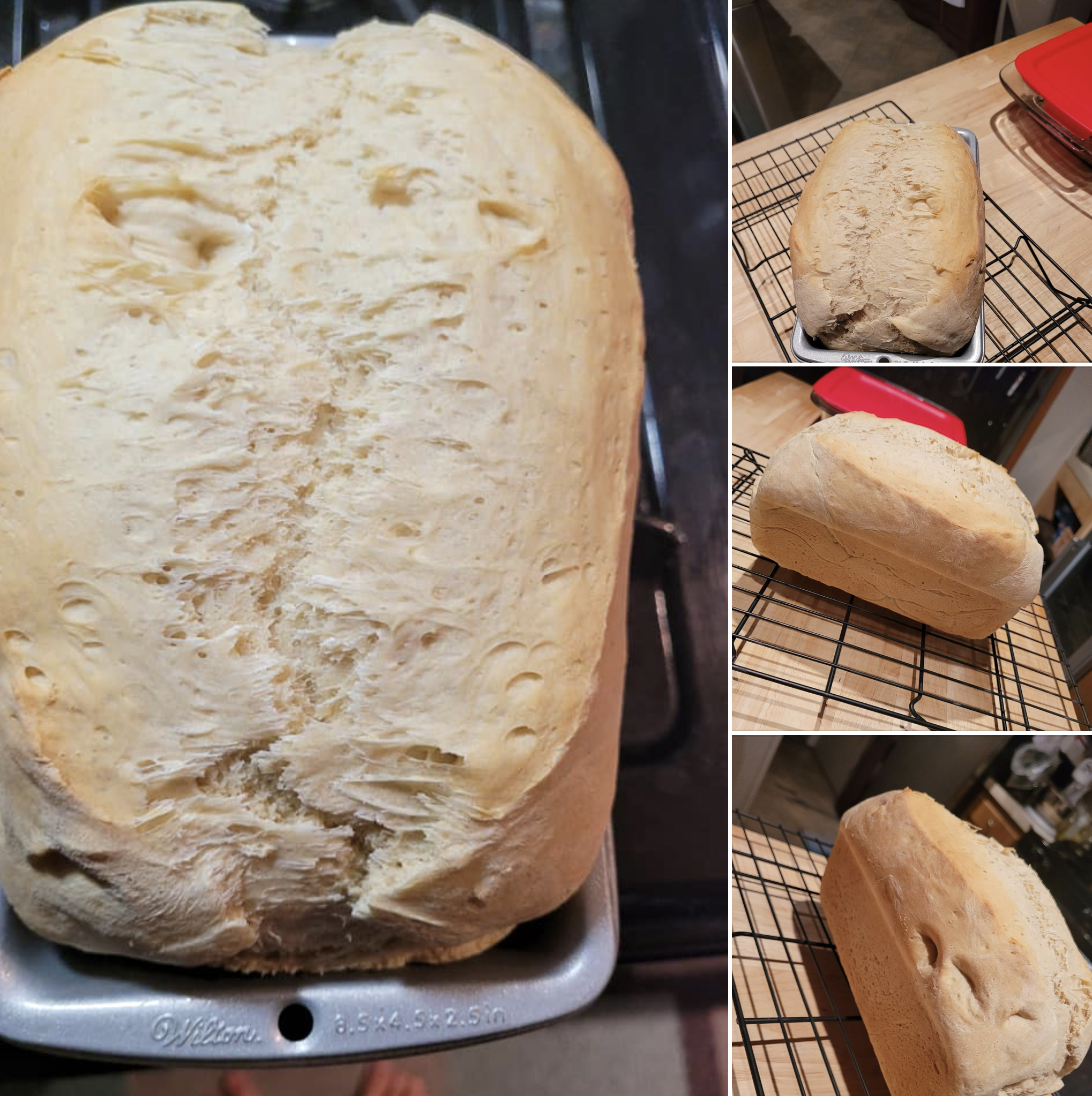
One of my viewers sent me these beautiful photographs of her bread using this recipe and technique. She couldn't stop making loaves ... Thanks, Michelle! 


My favorite breakfast, especially with homemade jams.


Notes: olive oil will produce a softer dough than shortening.  Bread slices best the following day and allows thinner slices. Never cut bread just out of the oven. Allow it to cool or the steam will escape producing a dry texture. Also, never cut off both ends or "heels" even though people may beg for those cuts; it makes cutting the rest of the loaf difficult if not impossible.

A note on yeast: I use Fleishman's Quick Rise. In the North, yeast is always found in the refrigerated dairy section. Where I'm at in the South it is found in the baking section, so I always double-check the expiration date and I store unused yeast in the freezer. My favorite yeast is the old-fashioned "cake yeast." It gives the best flavor, but it is almost impossible to find. 

Here is 93-year-old Clara making bread as she remembers her mother did from the Great Depression. Fascinating technique.


Keep your stale bread. Until I saw this video, I always threw away stale bread. Not anymore. If you have children, sub the water for warm milk, and use a sprinkle of sugar instead of salt. A whiff of cinnamon is nice, too. 


Thursday, February 7, 2013

Chicken Legs with Dry Spices and Lard


This is the perfect kind of recipe you want when you don't have much time in the kitchen, but you want something warm and satisfying. Most likely, you already have the spices in your kitchen.

Everyone should keep some lard. It keeps for quite a long time in the refrigerator and, in many ways, is better than butter or margarine.

This package of five chicken legs was less than three dollars. But I can't figure out why they are not packaged six. I like to think two legs per chicken and that no one's leg travelled afar . . .


  • 1/2 teaspoon garlic powder
  • 1/2 teaspoon onion powder
  • 1/2 teaspoon Old Bay's
  • 1/4 teaspoon cumin powder
  • 1/2 teaspoon Lawry's Seasoned Salt
  • 1/4 teaspoon black pepper
  • 1/2 teaspoon dried thyme leaves, lightly crushed
  • Olive oil
  • 2 tablespoons lard
  • Kosher salt


Mix the dry ingredients together. You should have about one tablespoon. Lightly rub into room-temperature chicken legs to cover. Lightly drizzle with olive oil. I'd say no more than 1-2 tablespoons. You are not making a marinade, you just want to wet the dried spices to activate them. If possible, allow to sit, covered, for an hour or so.


Add two tablespoons of lard to a 10-inch cast-iron skillet. When shimmering, add the legs. Be careful, they will sputter as they cook and release their juices.

Chicken legs really have four sides. Cook for about 15-20 minutes over medium-high heat just until they are golden brown.

Place in a pre-heated 375 F oven and cook for an additional 15-20 minutes, turning once or twice, until golden brown and crusty. Remove pan from oven. Remove legs from pan and place on paper towel then on a rack or plate to cool a bit. Sprinkle with Kosher salt and enjoy! 


You could easily make a pan gravy from the drippings. Or, if you're bad like me, use them to dip in chunks of crusty bread. I served with this cole slaw--the kind you buy in the grocery store already shredded and with it's own pack of dressing. Doesn't get much easier than that!

Wednesday, January 16, 2013

Apple Slump


Summer fruits are but a memory: juicy, ripe peaches and nectarines; plump, sweet strawberries and blueberries. Much of the "summer" produce now appearing on grocery store shelves is shipped south of the equator, and that includes grapes. 

Let's face it. This is the season of apples and citrus. And right now, produce bins are overflowing with apples: Honeycrisp, Jazz, Fuji, Braeburn, Macintosh, Red and Gold Delicious. We have a way to go before local fruits find their way into our kitchen and back into our hearts. But for now, I'll take this apple cake anytime of the year!

This is an adaptation from my 4-Peach Cobbler. I subbed apples for the peaches. Use a firm tart apple, such as Jazz, which will stand up to the wonderful combination of whiskey, cinnamon and allspice. You don't want a soft apple that will turn to mush.

It's important to use the correct pan for this recipe. I use a glass Pyrex 10 x 7 x 2 dish. Because of the baking powder, this cake has a nice rise to it, so you don't want something shallow.

Is it a cake? A cobbler? A slump? I've settled for 'slump' since the apples will fall or slump to the bottom as the cake batter rises to the top. You could sub rum for the whiskey, or just water. I've made this several times now and I'm hooked. Unlike Quick Apple Cake, this recipe has no eggs.


Apple Filling

  • 2-and-one-half apples, peeled and cored
  • 1/4 cup whiskey
  • 1 heaping teaspoon cinnamon
  • 6 allspice berries, crushed with a mortar and pestle
  • several grates of fresh nutmeg/a tiny pinch of ground cloves
  • 2 tablespoons butter
  • 2 tablespoons dark brown sugar
  • A squeeze of fresh lemon juice if you your apples are bland (1-2 teaspoons)


Batter

  • 1/2 cup butter (1 stick)
  • 1 cup milk
  • 1 cup flour
  • 1 cup sugar
  • 2-3 teaspoons baking powder
  • 1/2 teaspoon vanilla


Topping

  • 2 tablespoons sugar mixed with
  • 1 teaspoon cinnamon


A melon baller makes easy work of "coring" an apple that has been cut in half.

Cut each half-apple into fourths and then cut them in half so you have nice-sized chunks.  Keep a few slices whole. Place all ingredients in a medium pan and cook over medium heat for about 8-10 minutes just until the apples begin to soften, release their juices, and begin to make a "syrup." If necessary, add a bit more liquid/butter. In the meantime . . .


The apple chunks are tender soft and have made a lovely syrup.

Place the stick of butter into the 10 x 7 x 2 pan and pre-heat oven to 400 F. degrees. Allow the butter to melt and to begin to brown a bit . . . meantime . . .

In a medium bowl, whisk the flour, sugar, milk, vanilla and a dash of table salt until smooth.

Remove dish from oven. Pour the batter into the hot dish with the melted butter. Now evenly spoon the apple mixture across the top. Sprinkle with the sugar/cinnamon mixture.

Return to oven and bake at 400 F for about 25 minutes or until the top is set. Allow to cool before cutting/serving. This cake improves with age, but it's rare to have it last over one day. If desired, serve with a bit of whipped cream.


Notes: Use whatever spices you wish. Always go easy on cloves since they are overpowering. I use about less than one tablespoon baking powder (which is about 3 teaspoons). Use less if your baking powder is fresh. You should always keep it in the freezer. One could, of course, add nut meats, such as walnuts to the apples. Or dried fruit, such as raisins or cranberries.